3V0-21.25응시자료, 3V0-21.25최신버전공부문제
Wiki Article
다년간 IT업계에 종사하신 전문가들이 자신의 노하우와 경험으로 제작한 VMware 3V0-21.25덤프는 3V0-21.25 실제 기출문제를 기반으로 한 자료로서 3V0-21.25시험문제의 모든 범위와 유형을 포함하고 있어 높을 적중율을 자랑하고 있습니다.덤프구매후 불합격 받으시면 구매일로부터 60일내 주문은 덤프비용을 환불해드립니다.IT 자격증 취득은 DumpTOP덤프가 정답입니다.
VMware 3V0-21.25 시험요강:
| 주제 | 소개 |
|---|---|
| 주제 1 |
|
| 주제 2 |
|
| 주제 3 |
|
| 주제 4 |
|
| 주제 5 |
|
퍼펙트한 3V0-21.25응시자료 최신버전 문제
우리DumpTOP 사이트에VMware 3V0-21.25관련자료의 일부 문제와 답 등 문제들을 제공함으로 여러분은 무료로 다운받아 체험해보실 수 있습니다. 여러분은 이것이야 말로 알맞춤이고, 전면적인 여러분이 지금까지 갖고 싶었던 문제집이라는 것을 느끼게 됩니다.
최신 VCAP Automation 3V0-21.25 무료샘플문제 (Q39-Q44):
질문 # 39
An administrator is tasked with configuring an existing Organization to enable users to create namespaces with GPU resources on their assigned Projects.
The Organization is backed by a Region with a GPU-enabled supervisor on a single zone setup.
What needs to be configured for this requirement?
- A. NVIDIA GPU Operator.
- B. NVIDIA grid_al00-40c profile.
- C. Namespace Class with VM Class Reservations.
- D. GPU enabled VM Classes.
정답:C
설명:
To deliver GPU resources to tenant users in VCF 9.0, the administrator must bridge the physical hardware to the logical project via a Namespace Class. Specifically, the administrator must create or modify a Namespace Class to include VM Class Reservations for GPU-enabled classes. In VCF 9.0, a "Namespace Class" defines the templates and limits for the Kubernetes namespaces that users can create. By adding a GPU-enabled VM Class (such as one utilizing NVIDIA vGPU profiles) to the reservation list within the Namespace Class, the administrator ensures that the Supervisor knows to prioritize and reserve those specific hardware resources for workloads deployed into that namespace. Once this Namespace Class is bound to the user's Project, the users can then select the GPU-enabled classes when deploying their containers or VMs, fulfilling the requirement for high-performance compute within the multi-tenant environment.
질문 # 40
An Organization Administrator notices that their public assigned IPs are being used for non-production workloads.
What should the administrator do to prevent further public IP addresses consumption?
- A. Create an IP Quota and associate it with the non-production namespace.
- B. Modify the existing VPC and remove the "External IPv4 blocks".
- C. Modify the default IP Quota that was shared by the provider.
- D. Create an IP Quota and associate it with the non-production VPC.
정답:D
설명:
In the VCF 9.0 networking model, IP Quotas are the primary governance mechanism for controlling resource consumption within an Organization. When a Provider allocates IP blocks to an Organization, the Organization Administrator is responsible for sub-allocating those resources to individual projects or environments. To prevent non-production workloads from exhausting the pool of public (external) IP addresses, the administrator must Create an IP Quota specifically for the non-production Virtual Private Cloud (VPC). This quota defines the maximum number of public IP addresses that can be used for services such as Load Balancers or NAT rules within that specific VPC. Once the quota is reached, any further requests for public IPs in that VPC will be denied by the VCF Automation engine, ensuring that a sufficient supply remains available for production-critical workloads. Modifying the provider-shared quota (Option C) would affect the entire organization, and removing external blocks (Option D) would break existing connectivity rather than provide proactive governance.
질문 # 41
A customer requires a backup of blueprints within VMware Cloud Foundation (VCF) Automation to a third- party solution each time the blueprint is released.
What construct will satisfy the requirement?
- A. ArgoCD service
- B. CloudConfig
- C. Velero service
- D. Event broker subscription
정답:D
설명:
To automate the export or backup of Blueprints (Cloud Templates) in VCF 9.0, the Event Broker Service (EBS) is the required mechanism. While Velero (Option A) is used for backing up vSphere Pods and ArgoCD (Option C) is for continuous delivery, neither is designed to "listen" for internal automation metadata changes.
By creating an Event Broker Subscription mapped to the "Blueprint Released" or "Template Version Created" topic, the administrator can trigger an action every time a developer finalizes a new version of their infrastructure code. This triggered action (typically an ABX or Orchestrator task) can then programmatically retrieve the YAML definition of the blueprint via the VCF Automation API and push it to an external third- party storage solution or a secondary Git repository for long-term archival and backup. This ensures that the organization maintains a complete, off-appliance history of its infrastructure designs, satisfying auditing and disaster recovery requirements.
질문 # 42
An administrator is tasked with configuring a multi-tenant environment within the organization's VMware Cloud Foundation (VCF) deployment. Requirements are:
* isolated network spaces for development and testing.
* dedicated resources.
* role-based access control.
Which of the actions satisfies the requirement?
- A. Configure firewall rules at the datacenter edge level to isolate traffic between departments.
- B. Grant full administrative access for one responsible user in each department to create and manage their own network configurations.
- C. Create an NSX backed VLAN segment per department.
- D. Define and allocate IP blocks and quotas at the organization level, which will then be consumed by the NSX VPCs created by the different departments.
- E. Define and allocate IP blocks and quotas at the organization level, which will then be selected and consumed by users at deployment.
정답:D
설명:
The introduction of Virtual Private Clouds (VPCs) in VCF 9.0 is the primary mechanism for achieving isolated networking in a multi-tenant environment. The correct administrative workflow involves the Provider or Organization Administrator defining IP Blocks and Quotas at the Organization level. These resource allocations act as a "bucket" of capacity from which individual departments or projects can draw. When a department creates an NSX VPC, it automatically consumes these pre-allocated IP ranges for its internal segments and services, ensuring that development and testing environments remain logically isolated at the network layer without requiring manual intervention for every subnet creation. This "consumption-based" model ensures that while departments have the flexibility to manage their own VPC resources, they remain constrained by the governance and RBAC policies defined at the higher Organization level. This approach significantly reduces the operational overhead compared to traditional VLAN segment management or complex edge firewall rules.
질문 # 43
A company has deployed an new VMware Cloud Foundation (VCF) Fleet within their development environment. An administrator has been tasked with configuring the organization for VM Apps so that developers can start to create new cloud templates and catalog items.
When creating the organization for VM Apps, the administrator successfully configured access control and assigned Organization-level and Service-level roles to the correct users and groups.
Drag and drop the five steps the administrator must take from the Steps list into the Ordered Steps list and place them in the correct order so that the objective is completed.
(Choose five.)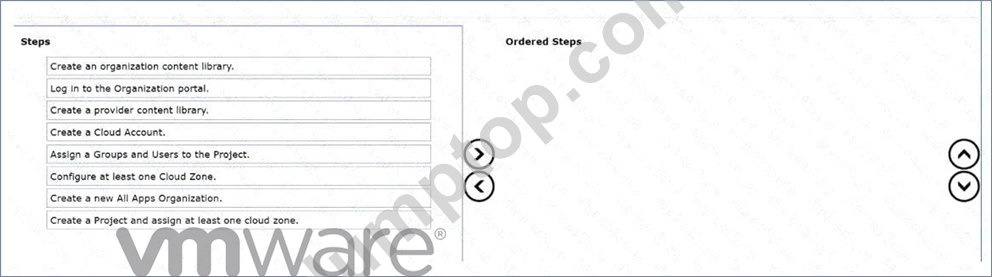
정답:
설명: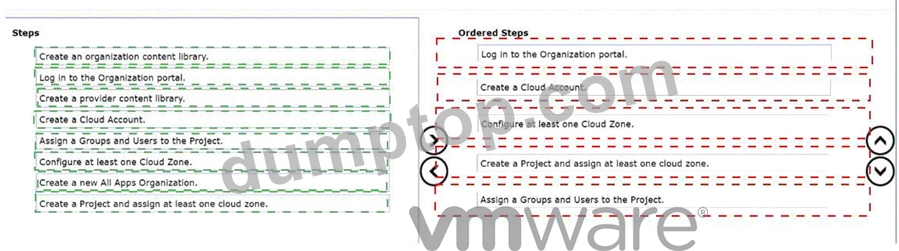
Explanation:
VM Apps Organization Configuration
Verified answer:
* Log in to the Organization portal.
* Create a Cloud Account.
* Configure at least one Cloud Zone.
* Create a Project and assign at least one cloud zone.
* Assign a Groups and Users to the Project.
In VMware Cloud Foundation (VCF) 9.0, configuring a VMApps Organization for developer self-service follows a specific hierarchical workflow once the initial organization creation and role assignments are complete. The administrator must first Log in to the Organization portal to perform tenant-specific resource management.
The first technical requirement is to establish a connection to the underlying infrastructure by choosing to Create a Cloud Account. This account integrates the tenant's view with the vCenter and NSX Manager resources provided by the fleet administrator. Once connectivity is established, the admin must Configure at least one Cloud Zone. In the VMApps model, the Cloud Zone is the construct that defines which compute clusters, storage policies, and networks are available for workload placement.
To enable consumption, the administrator must Create a Project and assign at least one cloud zone.
The Project serves as the primary governance boundary where resource quotas and cloud templates are managed. Finally, the administrator must Assign Groups and Users to the Project. This entitlement step ensures that developers have the necessary permissions (e.g., Project Administrator or Member) to consume the infrastructure and create the required catalog items within their isolated environment.
질문 # 44
......
많은 분들은VMware 3V0-21.25인증시험이 아주 어려운 것은 알고 있습니다. 하지만 우리DumpTOP를 선택함으로VMware 3V0-21.25인증시험은 그렇게 어렵지 않다는 것을 알게 될 것입니다. Pass4Tes의VMware 3V0-21.25합습가이드는 시험의 예상문제부터 전면적이로 만들어진 아주 퍼펙트한 시험자료입니다. 우리의 서비스는VMware 3V0-21.25구매 후 최신버전이 업데이트 시 최신문제와 답을 모두 무료로 제공합니다.
3V0-21.25최신버전 공부문제: https://www.dumptop.com/VMware/3V0-21.25-dump.html
- 시험대비 3V0-21.25응시자료 덤프 최신 데모문제 ???? 지금⇛ www.passtip.net ⇚을(를) 열고 무료 다운로드를 위해⮆ 3V0-21.25 ⮄를 검색하십시오3V0-21.25인증시험 덤프문제
- 3V0-21.25높은 통과율 시험대비자료 ⏪ 3V0-21.25시험패스 인증덤프공부 ???? 3V0-21.25최신 업데이트버전 덤프문제공부 ???? 무료로 다운로드하려면⇛ www.itdumpskr.com ⇚로 이동하여“ 3V0-21.25 ”를 검색하십시오3V0-21.25퍼펙트 최신 덤프문제
- 3V0-21.25최신 업데이트버전 덤프문제공부 ???? 3V0-21.25최신 업데이트버전 덤프 ???? 3V0-21.25최신 시험 최신 덤프 ???? ➤ 3V0-21.25 ⮘를 무료로 다운로드하려면▛ www.dumptop.com ▟웹사이트를 입력하세요3V0-21.25높은 통과율 시험대비자료
- 3V0-21.25응시자료 최신 시험 최신 덤프자료 ???? ▶ www.itdumpskr.com ◀에서▷ 3V0-21.25 ◁를 검색하고 무료로 다운로드하세요3V0-21.25최신 시험 최신 덤프
- VMware 3V0-21.25 인증 덤프 ???? ➽ www.koreadumps.com ????을(를) 열고⇛ 3V0-21.25 ⇚를 입력하고 무료 다운로드를 받으십시오3V0-21.25적중율 높은 인증덤프
- 시험패스 가능한 3V0-21.25응시자료 공부문제 ☂ 지금{ www.itdumpskr.com }에서▷ 3V0-21.25 ◁를 검색하고 무료로 다운로드하세요3V0-21.25덤프문제은행
- 시험대비 3V0-21.25응시자료 덤프 최신 데모문제 ???? ➤ www.koreadumps.com ⮘을(를) 열고✔ 3V0-21.25 ️✔️를 입력하고 무료 다운로드를 받으십시오3V0-21.25인증시험 덤프문제
- 시험대비에 가장 적합한 3V0-21.25응시자료 덤프샘플문제 다운로드 ???? 지금➡ www.itdumpskr.com ️⬅️을(를) 열고 무료 다운로드를 위해“ 3V0-21.25 ”를 검색하십시오3V0-21.25퍼펙트 최신 덤프문제
- 3V0-21.25응시자료 최신 시험 최신 덤프자료 ???? 《 kr.fast2test.com 》의 무료 다운로드【 3V0-21.25 】페이지가 지금 열립니다3V0-21.25최신 시험 최신 덤프
- 시험대비에 가장 적합한 3V0-21.25응시자료 덤프샘플문제 다운로드 ???? 지금➤ www.itdumpskr.com ⮘을(를) 열고 무료 다운로드를 위해[ 3V0-21.25 ]를 검색하십시오3V0-21.25퍼펙트 덤프공부문제
- 3V0-21.25적중율 높은 인증덤프 ???? 3V0-21.25최신 시험 최신 덤프 ???? 3V0-21.25시험대비 최신버전 덤프샘플 ???? 오픈 웹 사이트“ kr.fast2test.com ”검색“ 3V0-21.25 ”무료 다운로드3V0-21.25최신 업데이트버전 덤프
- www.stes.tyc.edu.tw, roryiesq852381.topbloghub.com, www.stes.tyc.edu.tw, www.stes.tyc.edu.tw, xandernkex035519.wikievia.com, www.stes.tyc.edu.tw, mohamadxmjv647541.bloggerswise.com, joanjvot753130.blogrelation.com, elijahawpg834762.celticwiki.com, prestonzrfo928746.thenerdsblog.com, Disposable vapes